Office moving vs residential moving in Durham—are they really that different? Absolutely. While both involve transporting belongings from one place to another, the similarities end there. Office moves require specialized planning, equipment, and expertise that residential moves simply do not need. This guide breaks down every key difference between commercial and home relocation. You will learn about planning complexity, equipment requirements, timeline pressures, security considerations, and cost structures. By the end, you will understand exactly why your business needs a different approach than your home would.
Why the Distinction Matters for Your Business
Many business owners assume any mover can handle their office relocation. They call the same company that helped them move house. This assumption often leads to problems.
Office moves involve higher stakes. Every hour of downtime costs money. Employees cannot work. Client meetings get cancelled. Deadlines slip. Residential moves have flexibility. You can unpack over weeks.
The items being moved differ completely. Homes contain sofas, beds, and personal items. Offices contain computers, servers, confidential files, and specialized furniture. Each category needs different handling.
The scale and complexity vary dramatically. A house move might involve 50-100 boxes. An office move can involve thousands of items with complex interdependencies. Computers connect to networks. Phones tie into systems. Furniture assembles in specific ways.
According to relocation experts, businesses that use residential movers for office relocation experience 60% longer downtime and 40% more equipment damage . These statistics explain why commercial moving vs residential moving Durham matters as a distinction.
Key Difference 1: Planning and Coordination Complexity
Residential moves follow simple patterns. You pack, movers transport, you unpack. Office moves require orchestrated coordination.
Office relocation process Durham involves multiple stakeholders. IT teams must prepare servers. Department managers coordinate their staff. Building management needs notification. Utility providers schedule connections. Professional movers coordinate all these elements.
Timeline development differs significantly. Residential moves happen on a single day. Office moves often span multiple phases. IT equipment moves separately from furniture. Different departments relocate at different times to maintain operations.
Contingency planning matters more for offices. What if the network isn’t ready? What if key equipment gets delayed? Professional movers develop backup plans for every scenario. Residential moves rarely need this level of planning.
Vendor coordination adds complexity. Office moves often involve electricians, cabling specialists, and IT consultants. Professional movers coordinate these vendors. Residential moves typically involve only the moving company.
According to business relocation planning Durham experts, thorough planning separates successful office moves from chaotic ones . The planning phase often takes weeks, not days.
Key Difference 2: Equipment and Items Being Moved
The contents of offices and homes could not be more different. Each requires specific handling expertise.
Office equipment includes technology. Computers, servers, printers, and network gear need special care. Professional movers use anti-static materials. They document cable connections. They understand which items need climate control. Residential movers may lack this expertise.
Office furniture differs from home furniture. Modular workstations, cubicles, and executive desks require disassembly and reassembly. Each system has specific procedures. Professional office movers bring tools and knowledge for these tasks. Residential movers typically handle standalone furniture that does not disassemble.
Confidential files need security protocols. Offices contain sensitive information. Payroll records. Client files. Legal documents. Professional movers maintain chain of custody. They use secure transport methods. Residential movers treat documents like any other box.
Specialty items appear more in offices. Medical equipment, lab instruments, and industrial tools require expertise. Professional office equipment moving Durham specialists understand these needs. Residential movers do not.
According to moving industry data, offices contain an average of 300% more items per square foot than homes . More items mean more complexity.
Key Difference 3: Timeline and Scheduling Pressures
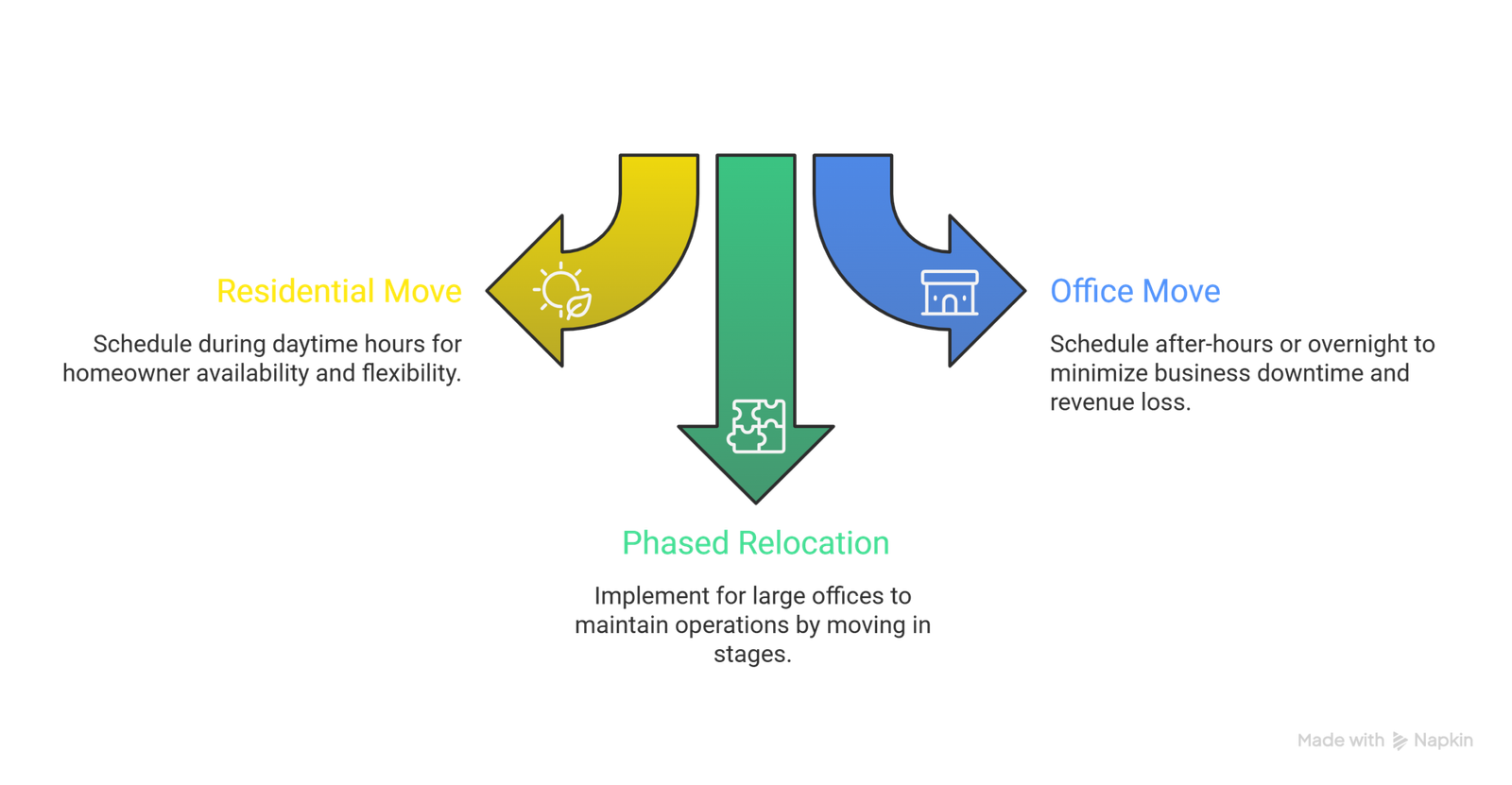
Residential moves work around your personal schedule. Office moves work around your business operations.
Downtime costs drive scheduling decisions. Every hour your office cannot operate loses revenue. Professional movers structure everything to minimize this downtime. They work evenings, weekends, and overnight. You arrive to a functional workspace.
After-hours moving is standard for offices. Residential moves typically happen during daytime hours when homeowners are available. Office moves deliberately happen when employees are gone. This fundamental difference affects everything about the move.
Phased relocations maintain operations. Large offices often move in stages. Marketing moves one weekend. Sales moves the next. IT moves last. Business continues throughout. Residential moves happen all at once.
Deadlines are non-negotiable for offices. Lease start dates create firm deadlines. You must be out by a specific date. Professional movers guarantee these timelines. Residential moves offer more flexibility.
According to corporate moving services Durham providers, 90% of office moves require after-hours scheduling . This statistic highlights how differently commercial and residential moves operate.
Key Difference 4: Security and Confidentiality
Security concerns differ dramatically between homes and offices.
Confidential information requires protection. Offices contain client data, financial records, and proprietary information. Professional movers have protocols for handling sensitive materials. They maintain chain of custody throughout transport.
Employee privacy matters during office moves. Personnel files contain sensitive information. Professional movers treat these items with appropriate discretion. Residential moves involve only personal items.
Access control differs. Offices may have security systems, key card access, and alarm codes. Professional movers coordinate with building security. They ensure proper access without compromising safety.
Data security extends to IT equipment. Hard drives contain information even when powered off. Professional movers understand data security requirements. They handle equipment in ways that protect your information.
Residential moves involve personal privacy but not corporate secrets. The security bar is simply lower.
According to IT equipment moving for offices Durham specialists, data breaches during moves, while rare, can be catastrophic . Professional movers prevent this risk.
Key Difference 5: Cost Structure and Value
How movers calculate costs differs between residential and commercial moves.
Residential moves typically charge by the hour. A crew works, you pay for their time. Simple and straightforward for homes.
Office moves use more complex pricing. Factors include office size, equipment types, timing requirements, and special handling needs. Professional movers provide detailed quotes reflecting this complexity.
Value calculation differs. For residential moves, lowest price often wins. For office moves, value matters more than cost. Minimizing downtime saves money that dwarfs moving fees. Protecting expensive equipment prevents replacement costs.
Hidden costs appear differently. Residential moves may have surprise charges for stairs or long carries. Office moves have these too, but also include IT coordination, after-hours premiums, and vendor management.
Return on investment matters for offices. Professional commercial movers vs residential movers Durham analysis shows that spending more on specialists saves money overall through reduced downtime and damage prevention.
Key Difference 6: Logistics and Access Considerations
Offices present logistical challenges that homes rarely pose.
Building management coordination adds complexity. Commercial buildings have rules about move times, elevator usage, and loading docks. Professional movers coordinate these details. Residential moves typically involve single-family homes with simpler access.
Parking restrictions differ. City centre offices in Durham may have limited loading zones. Professional movers understand permit requirements. They know which streets allow truck parking. Residential neighborhoods often have simpler parking.
Multiple floors require planning. Offices in high-rise buildings need elevator coordination. Professional movers schedule elevator access and protect hallways. Residential moves in apartments face similar issues but on smaller scales.
Loading dock requirements add complexity. Some offices require specific loading procedures. Professional movers bring equipment that works with commercial loading facilities.
Neighbour considerations matter more for offices. Shared buildings have multiple tenants. Professional movers minimize disruption to other businesses. Residential moves primarily affect one household.
According to office relocation checklist Durham guides, access planning should begin weeks before moving day . Professional movers handle this entirely.
Key Difference 7: Impact on People
The human element differs fundamentally between move types.
Residential moves affect family members. The emotional connection to home creates stress. But families can adapt gradually.
Office moves affect entire teams. Dozens or hundreds of employees depend on the move going smoothly. Their productivity, morale, and work experience hang in the balance.
Professional movers minimize employee disruption. They work when staff are gone. They set up workspaces before employees arrive. They create environments where people can work immediately.
Communication requirements differ. Office moves require keeping entire workforces informed. Professional movers provide updates that managers share with teams. Everyone knows what to expect.
Post-move support matters more for offices. Employees need functional workspaces immediately. Professional movers provide setup and support. Residential moves offer more time for gradual unpacking.
According to professional office movers Durham data, employee satisfaction scores improve by 40% when professional movers handle relocation . Happy employees mean productive businesses.
Comparison Table: Office Moving vs Residential Moving
| Factor | Office Moving | Residential Moving |
| Primary Items | Computers, servers, cubicles, files, specialized equipment | Furniture, clothing, personal items, appliances |
| Timing | Evenings/weekends to minimize downtime | Daytime, flexible scheduling |
| Planning Horizon | Weeks to months | Days to weeks |
| Security Needs | Confidential data, chain of custody | Personal privacy |
| Cost Drivers | Downtime prevention, equipment protection, complexity | Volume, distance, labour hours |
| Coordination | IT, building management, multiple vendors | Primarily the moving company |
| Special Equipment | Anti-static materials, cable labeling, furniture tools | Dollies, pads, standard boxes |
| Post-Move | Immediate functionality required | Gradual unpacking acceptable |
Signs You Need Office Movers Specifically
Not every business move requires specialists. But certain situations demand business moving services Durham expertise.
You have servers or network equipment. Technology requires specialized handling. Residential movers lack this expertise.
You operate during business hours. After-hours moving requires commercial specialists. Residential movers typically work daytime.
You have modular furniture. Cubicles and workstations need proper disassembly. Professional office movers know these systems.
You handle confidential information. Document security matters. Office movers maintain appropriate protocols.
You cannot afford downtime. Every hour counts. Professional movers minimize disruption.
You have multiple departments. Phased relocation requires coordination. Office movers manage this complexity.
You are moving within a commercial building. Loading docks, elevator scheduling, and building coordination require experience.
If these describe your situation, professional office movers are essential.
How Metropolitan Movers Excels at Office Relocation
At Metropolitan Movers in Durham, we specialize in the unique challenges of office moving vs residential moving. With over 10 years of experience and a 98% customer satisfaction rate, we understand what businesses need. Our office movers in Durham team brings specialized training in IT equipment handling, furniture disassembly, and confidential document transport. We offer after-hours and weekend scheduling to minimize your downtime. Our transparent pricing means no hidden fees—just clear, honest quotes you can trust.
We treat your office move as the critical business event it is. Our comprehensive services include packing, transportation, setup, and post-move support. We coordinate every detail so you focus on running your company.
Ready to experience the difference professional office movers make? Contact Metropolitan Movers today for a free, no-obligation quote. Let us show you why Durham businesses trust us for their most important relocations.
Top 5 FAQs About Office vs Residential Moving
Can residential movers handle an office move?
Technically yes, but they lack specialized expertise. Residential movers may damage IT equipment, mishandle confidential files, and take longer. Professional difference between office and home relocation Durham knowledge prevents these problems.
Are office moves more expensive than residential moves?
Per item, office moves often cost more due to complexity. But when factoring downtime and equipment value, professional office movers deliver better ROI. Compare total costs, not just moving day prices.
How long does an office move take compared to a home move?
Office moves of equivalent square footage typically take longer due to equipment complexity. A 2,000 square foot office may need 1-2 days. A similar home might move in 4-6 hours.
Do I need to pack everything before office movers arrive?
Professional office movers offer packing services. They can handle everything or supplement your partial packing. Discuss options during quoting. Full-service packing saves your team’s time.
What should I look for in an office moving company?
Look for commercial experience, IT equipment handling expertise, after-hours availability, transparent pricing, and positive reviews from other Durham businesses. Verify credentials and insurance.