How long does it take to plan an office move in Durham successfully? The answer might surprise you. Most successful business relocations begin 6 to 12 months before moving day . This extended timeline for office moving in Durham allows for comprehensive preparation across every critical area. This guide walks you through each phase of your move, from initial planning to post-move stabilization. Follow this timeline to avoid costly mistakes, minimize downtime, and ensure your Durham business relocation succeeds.
Why a Structured Timeline Matters for Your Durham Office Move
Office relocation differs fundamentally from moving house. The stakes are higher. The complexity is greater. The margin for error is smaller.
According to relocation experts, businesses that follow structured timelines experience 50% less downtime and 40% fewer equipment damage incidents than those who rush . These statistics explain why professional planning matters.
A detailed office relocation schedule Durham serves as your roadmap through complexity. It transforms an overwhelming process into manageable phases. It assigns responsibilities and tracks progress. It ensures no critical detail falls through the cracks .
For Durham businesses, local considerations add another layer. Understanding commercial property markets in County Durham impacts your decisions. Navigating local regulations requires attention. Professional movers with regional expertise become invaluable partners .
Without a proper commercial moving timeline Durham, you risk costly mistakes. Missed deadlines. Forgotten tasks. Overspent budgets. Extended downtime. The right timeline prevents these problems before they occur.
Phase 1: The Foundation (12 Months Before Move)
The earliest phase sets the stage for everything that follows. Invest time now to save headaches later.
Review your current lease immediately. Check your expiration date and any break clauses. Most commercial leases run 5-10 years, often with a break clause at year five . Understanding these terms prevents penalties later. You may need to serve formal notice months in advance.
Assess your workplace strategy. Consider what your business truly needs. Is the location commutable for current employees? Does it add or reduce commuting times? Can customers access the offices easily? Is public transport nearby? Do you need parking?
Engage with your employees early. This is one of the most crucial parts of planning. Seek feedback on what works well in the current workplace and what they would like to change. Conduct an employee survey covering wellbeing and workspace preferences . Employees who feel heard adapt better to change.
Develop a preliminary budget. Include moving services, IT setup, new furniture, potential downtime, and leasehold improvements. Consider consultancy fees, legal costs, printing, employee overtime, lift engineers, building security, and recycling of redundant furniture . A clear budget keeps spending under control.
Phase 2: Building Your Team (10-12 Months Before)
You cannot do this alone. Assemble the right people early.
Appoint a move manager or project leader. This person oversees the entire relocation. They act as liaison between your company and all moving partners. They ensure communication flows and tasks stay on track .
Designate departmental move champions. From each department, appoint someone responsible for communicating to their team, being an advocate for the move, and ensuring tasks are completed on time . These champions create accountability throughout your organization.
Research potential office moving companies. Start looking for professional business move timeline Durham providers early. Look for commercial experience, proper licensing, and comprehensive insurance. Companies with long histories serving Durham bring valuable local knowledge .
Identify other key vendors. You may need IT consultants, electricians, cabling specialists, and cleaning services. Building relationships now prevents scrambling later.
Phase 3: Detailed Planning (6-9 Months Before)
With foundations laid and team assembled, detailed planning begins.
Create a comprehensive moving timeline. Develop clear milestones with deadlines. Share this timeline with all stakeholders. Always build in contingency for unexpected delays .
Conduct a thorough space analysis. Measure your new office space carefully. Complete a furniture audit listing everything you have and identifying additional needs. If buying new furniture, order now—lead times can stretch weeks .
Perform a filing audit and declutter. Remove unwanted items before packing. Scan documents to cloud-based storage to reduce physical files. Every item you eliminate is one less thing to move .
Develop detailed floor plans. Display these where employees can see them. Match existing furniture to the new layout. Supplement with new items as needed. Plan where departments, desks, and common areas will go .
Coordinate with IT providers early. Speak with your IT company about the move. Discuss server relocation, network setup, and internet installation at your new location. Schedule utility connections well in advance .
Phase 4: Vendor Selection and Budget Finalization (6 Months Before)
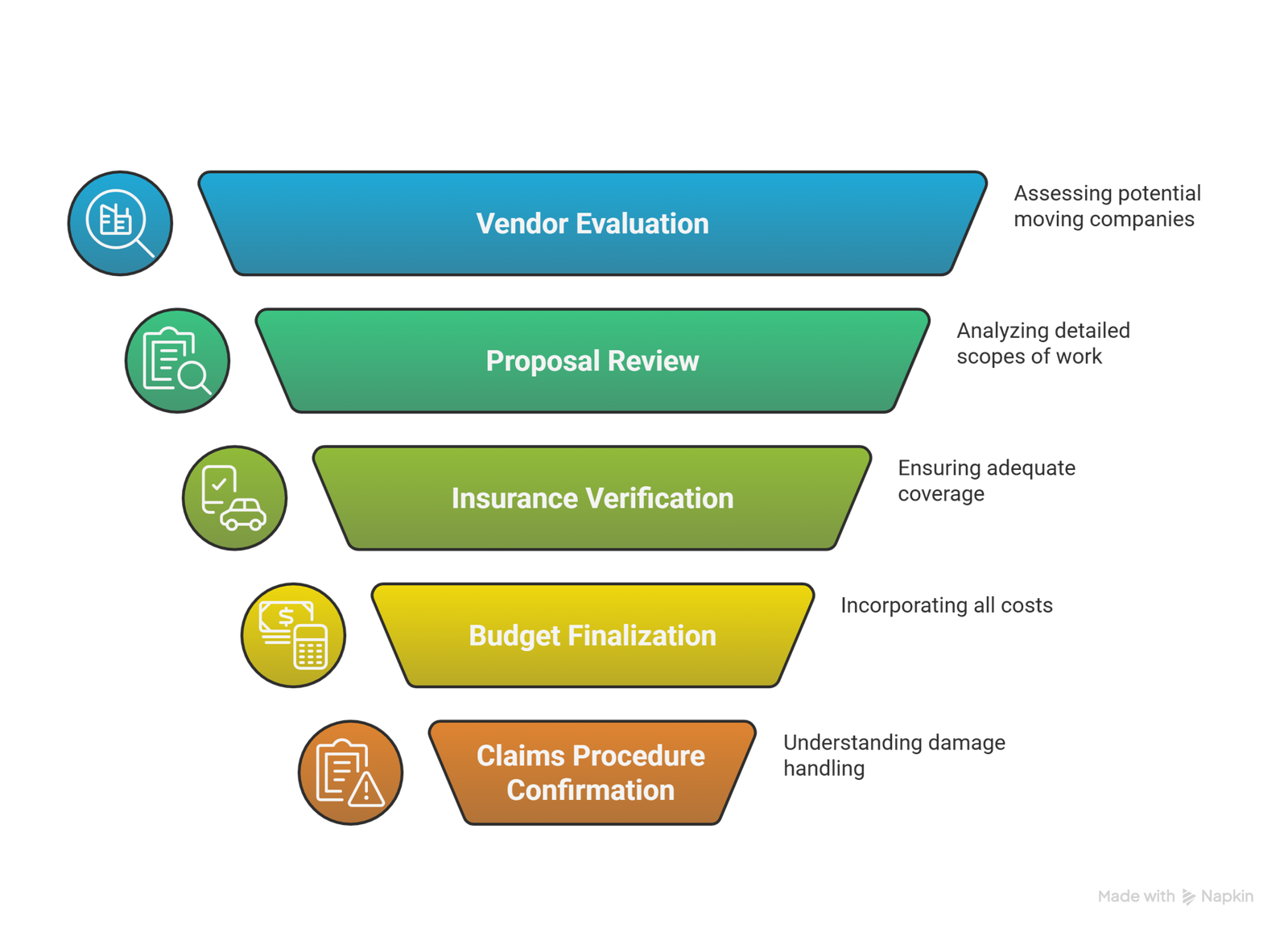
With plans drafted, finalize your partners and numbers.
Level bid responses and make vendor selections. Compare quotes from multiple moving companies. Request detailed proposals with defined scopes of work . Ask about:
- Experience with similar Durham businesses
- After-hours and weekend availability
- IT equipment handling protocols
- Furniture disassembly and reassembly
- Insurance coverage limits
- References from recent commercial clients
Obtain certificates of insurance from all vendors. Verify coverage meets your requirements. Understand claims procedures before any damage occurs .
Finalize your budget with real numbers. Include moving company fees, IT costs, legal fees, printing, stationary, employee costs for overtime, lift engineers, building security, new furniture, recycling of redundant items, and deep cleaning services .
Confirm damage claims and damage repair procedures. Know exactly how your movers handle problems. Clear protocols prevent disputes later .
Phase 5: Pre-Move Preparations (2-3 Months Before)
The countdown intensifies. Detailed preparation now prevents chaos later.
Order packing materials and schedule deliveries. Arrange delivery of crates and supplies one to two weeks before moving day . Professional movers often provide these, but confirm quantities early.
Develop a comprehensive labeling system. Use color-coded labels for different departments or destination rooms. Mark, tag, and color code every item to be moved. Photograph high-value items for potential damage claims .
Create employee move packets. Provide clear instructions about what staff need to do. Include timelines, packing guidance, and information about the new space. Prepared employees cause fewer problems .
Place individual room layouts on each office door. This gives installers quick reference during setup. Color code all furniture and equipment on floor plans of the new facility .
Schedule elevator service at both locations. Confirm access arrangements with building management. Arrange for any required permits or parking reservations .
Phase 6: Final Countdown (1 Month Before)
The finish line approaches. Focus on final confirmations.
Conduct pre-bid building tours if needed. Review access points, loading docks, and potential challenges. Brief your moving team on any unique considerations .
Confirm master move plan aligns with construction completion. Ensure your new space will be ready when movers arrive. Nothing derails a move like an unfinished building .
Arrange for distribution of parking and building access passes. Ensure everyone who needs entry has proper credentials. Confirm security and safety procedures with building management .
Assign individuals to pack common use areas. Kitchens, conference rooms, and reception need attention. Ensure someone owns each space .
Coordinate relocation of printers, copiers, and appliances. These items need special handling. Confirm service providers know the schedule .
Back up all critical data. Complete final backups of servers and computers. Verify backups work before equipment moves. Data loss is catastrophic and preventable .
Phase 7: Move Week and Moving Day
The moment arrives. Stay organized and communicate constantly.
Conduct a move orientation meeting with employees. Review final procedures. Answer questions. Address concerns. Informed teams cooperate better .
Confirm all details with your moving company. Review arrival times, crew sizes, and special instructions one more time. Ensure everyone is on the same page .
Prepare your current space. Clear pathways. Protect floors and walls. Have keys and access codes ready. A prepared space enables efficient moving .
Keep essentials accessible. Ensure moving day kits, medications, and critical items stay separate from general boxes. You need these items immediately .
Walk through both spaces. Inspect your current office before movers start. Note any pre-existing damage. Walk through your new space to confirm everything is ready .
Direct the moving team. Have your move coordinator on-site to guide movers and answer questions. Point out fragile items and priority areas. Clear direction prevents mistakes.
Do final walk-throughs. Before leaving your old space, check every room, closet, and cupboard. Ensure nothing gets left behind. At your new space, verify all items arrived .
Phase 8: Post-Move Setup and Stabilization
Moving day ends, but the process continues. Proper follow-up ensures long-term success.
Test everything immediately. Check internet connections, phone lines, and network functionality. Verify security systems work. Test individual workstations. Identify problems while movers and IT are still available .
Conduct damage inspection. Document any damage that occurred during the move. File claims promptly with your moving company. Photograph everything .
Complete unpacking systematically. Start with critical areas like reception and IT. Move through departments methodically. Discard packing materials as you go.
Communicate your new address officially. File change of address forms with post office, vendors, clients, and subscriptions. Consider maintaining your old phone number with a recorded message for six months .
Gather feedback from employees. Ask about their experience. Note what worked well and what could improve. Use these lessons for future moves .
Settle your old space. Complete final cleaning. Return keys and access cards. Schedule any required repairs. Close out your lease properly.
Office Relocation Timeline Summary Table
| Timing | Key Tasks |
| 12+ Months Before | Review lease, assess workplace strategy, engage employees, develop preliminary budget |
| 10-12 Months Before | Appoint move manager, designate move champions, research moving companies, identify vendors |
| 6-9 Months Before | Create timeline, conduct space analysis, perform filing audit, develop floor plans, coordinate with IT |
| 6 Months Before | Compare vendor bids, verify insurance, finalize budget, confirm claims procedures |
| 2-3 Months Before | Order packing materials, develop labeling system, create employee packets, schedule elevator access |
| 1 Month Before | Confirm building readiness, arrange access passes, assign packing responsibilities, coordinate equipment moves, back up data |
| Move Week | Conduct orientation, confirm mover details, prepare spaces |
| Move Day | Direct team, keep essentials accessible, conduct walk-throughs |
| Post-Move | Test systems, inspect for damage, unpack systematically, update address, gather feedback |
Common Timeline Mistakes to Avoid
Learn from others’ errors. These mistakes cost Durham businesses time and money.
Starting too late is the most common error. Insufficient planning leads to rushed decisions and overlooked details . Begin early.
Underestimating IT coordination time causes extended downtime. Technology requires careful planning. Involve your IT team from the beginning .
Failing to book movers early limits your options. Peak seasons book months ahead. Secure your preferred dates well in advance .
Skipping the declutter phase increases moving costs. Every unnecessary item adds time and expense. Purge ruthlessly before packing .
Not building contingency time creates pressure when delays occur. Always add buffer to your office moving timeline Durham. Unexpected issues always arise.
Forgetting post-move tasks prolongs disruption. Plan for unpacking, testing, and settling in. These activities need time too.
How Durham Businesses Benefit from Professional Timelines
Local experience confirms the value of professional office relocation planning.
Companies serving Durham understand regional logistics. They know traffic patterns on the A691. They understand parking restrictions in Framwellgate Moor. They anticipate challenges unique to Durham’s historic city centre .
Professional movers bring structured timelines developed through years of experience. They know exactly when to order supplies, when to schedule vendor coordination, and how long each phase truly takes .
Reviews consistently praise professional movers for excellent communication, efficient packing, and moves completed on schedule. Customers highlight how clear timelines reduced stress and kept everything organized .
For Durham businesses, local expertise matters. Professional movers understand regional commercial property markets, local regulations, and the unique challenges of relocating within County Durham.
Trust Metropolitan Movers for Your Durham Office Relocation Timeline
At Metropolitan Movers in Durham, we understand that following the right timeline for office moving in Durham determines your success. With over 10 years of experience and a 98% customer satisfaction rate, we help businesses execute flawless moves on schedule. Our office movers in Durham team brings specialized training in IT equipment handling, furniture disassembly, and confidential document transport. We offer after-hours and weekend scheduling to minimize your downtime. Our transparent pricing means no hidden fees—just clear, honest quotes you can trust.
We treat your office move as the critical business event it is. Our comprehensive services include packing, transportation, setup, and post-move support. We coordinate every detail so you focus on running your company.
Ready to plan your Durham office relocation with confidence? Contact Metropolitan Movers today for a free, no-obligation quote. Let us show you why Durham businesses trust us for their most important relocations.
Top 5 FAQs About Office Moving Timelines
How far in advance should I start planning an office move in Durham?
Start planning 6 to 12 months before your intended move date . This timeline allows for lease negotiations, budget development, vendor selection, and thorough preparation. Rushed moves lead to costly mistakes.
What is the most critical phase of an office relocation timeline?
Every phase matters, but the foundation phase (12+ months before) sets everything up for success. Proper early planning prevents problems throughout the entire process .
How long does a typical office move take to execute?
The physical move itself often takes one to three days, depending on office size. However, the overall office move step by step Durham process spans months of planning and weeks of post-move setup .
When should I notify employees about the office move?
Start communicating at least three months before the move. Provide regular updates as the corporate relocation schedule Durham develops. Early communication reduces anxiety and builds trust .
How much time should I allow for IT setup after the move?
IT setup requires at least one to two weeks of planning before the move and several days after. Schedule internet and phone installation at your new location before moving day if possible .